Showing posts with label
Chinese Jokes | Китайские шутки.
Show all posts
Showing posts with label
Chinese Jokes | Китайские шутки.
Show all posts
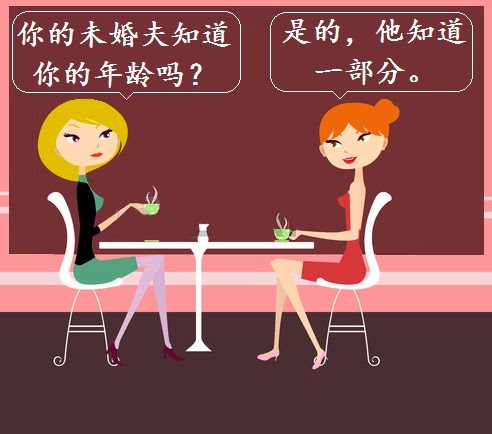
你的未婚夫知道你的年龄吗?
nǐ de wèi hūn fū zhī dào nǐ de nián líng ma
Does you fiance know your age?
是的,他知道一部分。
shì de tā zhī dào yī bù fèn
Yes, partly.
In Chinese language, 想 (xiǎng) basically means "to think", "to reckon" or "to miss", but it also acts as an auxiliary verb expressing modality.
In this case 想 is translated as "want to…" or "would like to…".
The grammar pattern is as follows:
Subject + 想(xiǎng) + Verb (Object)
The verb provides the main content of the clause, while 想 expresses the desire to do something.
Examples:
病人:“医生,你把剪刀留在我肚子里了。”
bìng rén: yīshēng, nǐ bǎ jiǎndāo liú zài wǒ dù zi lǐ le
Patient: "Doctor, you have left a pair of scissors in my stomach."
医生:“没关系,我还有一把。”
yī shēng: méi guān xì wǒ hái yǒu yī bǎ
Doctor: "It does not matter, I have another one."
Grammar Points
In Chinese language, ordinal numbers are formed by just adding the prefix:
第 (dì) + cardinal number
Порядковые числительные в китайском языке образуются по простой формуле:
第 (dì) + количественное числительное
E. g.:
- 第一 (dìyī) - the first - первый
- 第十 (dìshí) - the tenth - десятый